



Hotline 0086-519-86239986

All News
Choosing a single cylinder diesel engine starts with a clear sequence of decisions. International importers and distributors should work through seven steps in order:
Confirm market fit for the target region.
Match specifications to the driven equipment.
Verify regulatory compliance and certification.
Model the total cost of ownership.
Vet the supplier through audits and sample testing.
Plan logistics and customs clearance.
Secure after-sales support and spare parts.
This guide helps importers and distributors make each decision with confidence. The right engine fits the target market and the machines it will power. The lowest-priced unit rarely meets that test. Buyers who follow the sequence avoid costly surprises after the container arrives.
Follow the seven-step buying sequence to avoid costly surprises after delivery.
Match engine power and speed to the equipment it will drive for best performance.
Check emission and certification rules for your target market before shipping.
Calculate total cost of ownership, not just the purchase price, to protect your margin.
Vet suppliers with factory audits and sample testing to ensure quality and reliability.
Power ratings frame the first technical decision. A single cylinder diesel engine in this class typically spans 4hp to 25hp, and rated speed varies by model. Specifications decide whether the engine survives its first season in the field. The table below shows representative figures across the range.
Engine Model | Rated Power | Rated Speed |
|---|---|---|
R170A | 4 HP | 2600 rpm |
ZS1100 | 15 HP | — |
ZS1115 | 20 HP | 2200 rpm |
ZS1125 | 25 HP | — |
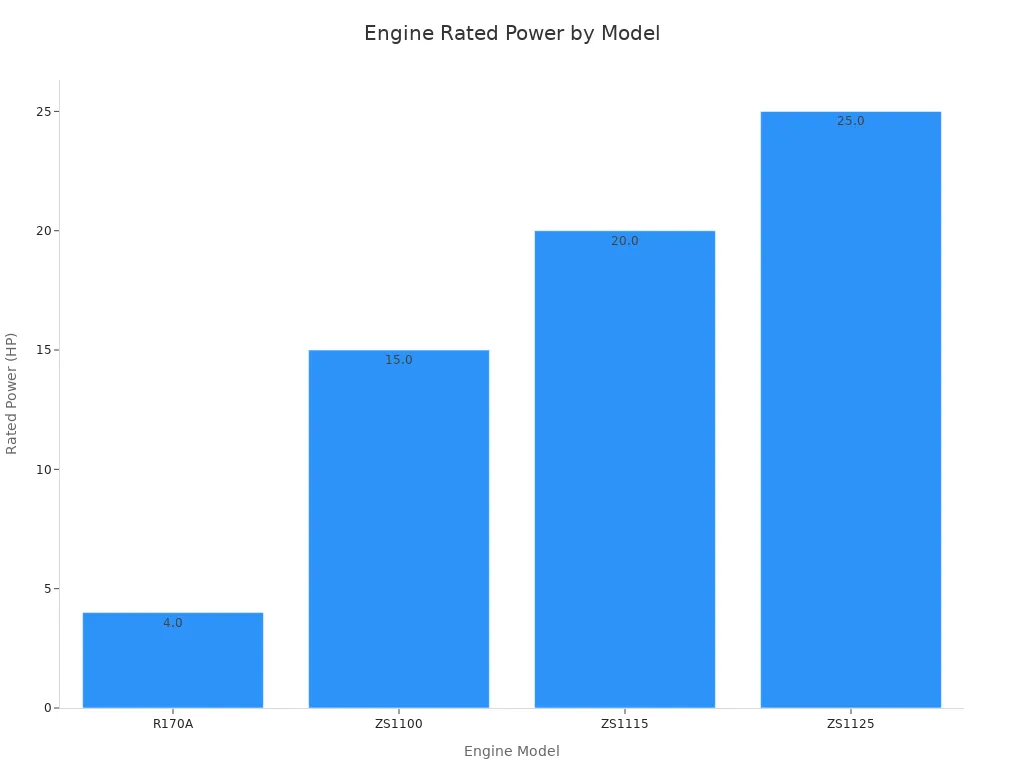
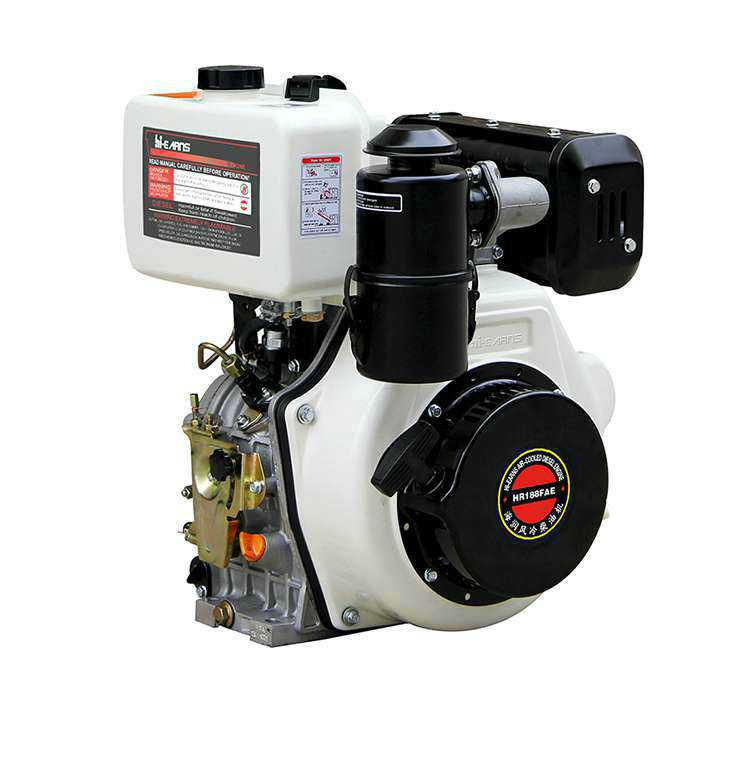
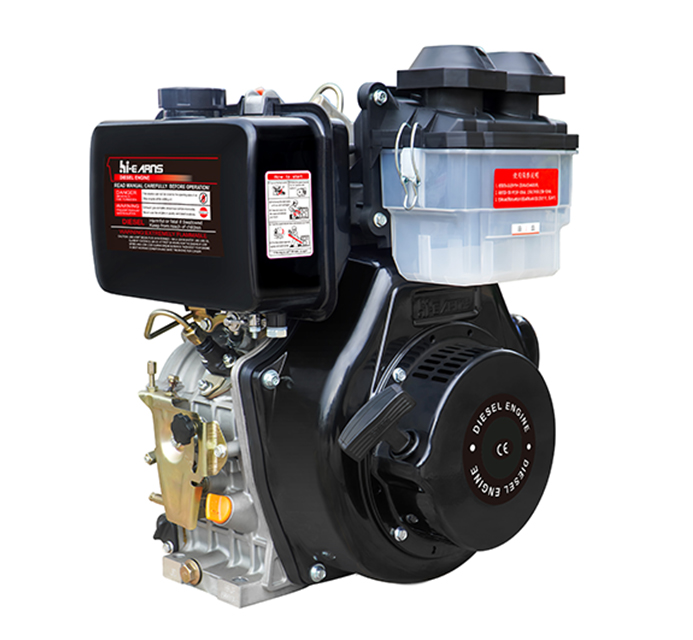
Buyers should match rated power to the driven equipment, not to the largest number on the catalog page. A generator, water pump, or plate compactor each draws a specific load. An oversized engine wastes fuel, and an undersized one stalls under demand. Rated speed also shapes the match. A 2600 rpm unit suits certain pumps and generators, while a 2200 rpm unit fits other applications. Buyers should check the equipment's required input speed before selecting a model. Published torque figures are often unavailable for these models. Importers should therefore request torque curves directly from the supplier and verify them on a sample unit before placing a volume order. Fuel use follows load and speed, so a well-matched engine delivers lower consumption per hour of work. A simple rule helps: list the equipment's continuous load, add a safety margin the supplier confirms, and pick the nearest model above that figure. Hi-earns illustrates the range well: air-cooled, 4-stroke units from 4hp to 25hp, including the 170F, HR178, 186FAE, 188F, HR1105, and HR998. Distributors who stock several power bands of single cylinder diesel engine models can serve more equipment types from one container and reduce the risk of dead stock.
Air cooling suits these engines because it removes the radiator, hoses, and coolant from the maintenance schedule. Cooling fins and fan design deserve a close look during inspection. Casting quality on the cylinder block and head predicts how the engine handles heat under continuous load. Starting method is a practical selection point. Recoil start keeps cost and complexity low and suits markets where users accept manual starting. Electric start adds a battery, starter motor, and charging circuit. It wins on larger units and in commercial fleets where downtime is expensive. Shaft type is the second selection point. A keyway shaft drives pulleys and couplings with a mechanical key. A taper shaft mounts directly to generator heads and similar tapers. Buyers should confirm the mating equipment before ordering, because the wrong shaft forces rework at the destination and erodes distributor margins.
Build quality separates durable engines from short-lived ones. The air filter is a strong indicator. Hi-earns fits a 5-stage dry-wet combined air filter rated at 99.9% filtration efficiency. That figure matters in dusty construction and agricultural sites where grit destroys cylinder walls. Importers should inspect filter design, cylinder head finish, and fastener quality during sample testing. These checks cost little during a factory visit and save far more after delivery. A supplier that documents these details in writing is easier to hold to a warranty claim later. The one-year warranty on Hi-earns units gives distributors a defined window to test field reliability before committing to repeat orders.
A single cylinder diesel engine powers equipment that runs intermittently at low to moderate load. Distributors see these units most often in diesel generators, water pumps, concrete vibrators, tamping rammers, and plate compactors. Agricultural buyers use them for irrigation pumps, power tillers, threshers, and small farm machinery. Telecom operators also deploy them at base stations where grid power is unreliable.
Agriculture stands out as the largest demand segment. It accounts for roughly 42.3% of global applications in 2025. Power generation, water management, and small construction machinery follow. The global market for these engines sits near USD 3.34 billion in 2025, with projections of about USD 3.74 billion by 2035.
Buyers should also compare configurations before ordering. Air-cooled engines come in single-cylinder and V-twin layouts. A V-twin offers more power from a compact footprint, while the single-cylinder design keeps weight, cost, and service simple. Matching the layout to the driven equipment prevents over-specification and protects margin.
Regional demand patterns differ sharply, and distributors should read them before building an inventory plan. Asia Pacific holds the dominant revenue share at 58.2%, which makes it the primary international market for these engines. In ASEAN markets, buyers use them for irrigation pumps, tillers, threshers, generators, and farm machinery in dusty, humid, high-load conditions.
North America and Europe reward compliance and efficiency. Buyers there prioritize emission-compliant, high-efficiency models for agriculture, construction, and backup power. Europe is shifting toward low-noise compact industrial units. Latin America, the Middle East, and Africa lean toward affordable, durable engines for irrigation and remote power. Off-grid power needs and unreliable grid infrastructure drive demand across much of Africa.
Emerging construction markets add another layer. Limited grid access supports portable generators and compact construction equipment. Distributors who map these drivers to their territory can stock the right power bands and avoid slow-moving inventory.
Compliance rules change by destination, and they can stop a shipment at the border. The United States enforces the strictest regime. Under the Clean Air Act, importers may not bring any nonroad engine or piece of equipment into the country unless it conforms to EPA emission standards. That rule covers generators, pumps, and other diesel-powered machinery, whether new or used. Every engine class introduced into commerce needs a Certificate of Conformity, and each certificate stays valid for only one model year of production.
An importer without manufacturer status must work through an Independent Commercial Importer (ICI). The ICI holds a valid EPA Certificate of Conformity for at least one model and follows the same emission requirements the Clean Air Act imposes on OEMs. Two other routes exist. A nonconforming engine may enter under a Customs bond with EPA pre-approval for testing, display, repair, or racing. Buyers should confirm the exact rule for their engine model before the container leaves port.
Chinese suppliers commonly hold ISO 9001 and CE as baseline credentials. Buyers should treat these as starting points, not blanket approvals. An ISO 9001 certificate is specific. One example, certificate No. 02925Q3D160R6M, covers the production and sales of single-cylinder diesel engines and accessories, including fuel tank assemblies, mufflers, and air filter assemblies. Importers should read the scope and confirm it names every model they plan to order.
Certification | Standard / Directive |
|---|---|
ISO 9001 | Quality Management Systems |
ISO 14001 | Environmental Management |
CE | Machinery Directive 2006/42/EC · EN ISO 8528 |
Euro V | EU Stage V emissions · Reg. (EU) 2016/1628 |
Verification takes little effort. Request a scanned certificate showing the factory name and validity date. Cross-check the certificate number on the issuing body's website, such as TÜV or SGS. Confirm the certification covers all models in the purchase order. A factory visit or virtual tour closes the loop. Suppliers holding ISO 9001 are more likely to maintain batch traceability and respond to non-conformances, which lowers operational risk for the distributor.
Purchase price is only the first line in the cost model. Importers should compare engines on lifetime cost instead. That figure includes the unit price, freight, duties, a warranty reserve, and spare-parts stocking. A cheaper engine with weak parts support often costs more across a three-year distribution cycle.
The West African market offers a useful sanity check. A standard 5–7 HP single cylinder diesel engine from a Chinese brand retails in Ouagadougou for roughly 95,000 to 150,000 XOF. Informal markets near the Route de Bobo corridor can quote 15–25% less. Those units often lack documentation, carry no parts history, and may be reconditioned engines sold as new. Distributors should treat such quotes as a warning, not a benchmark.
Engine category | Brand origin | Price range (XOF) | Approx. USD equivalent |
|---|---|---|---|
5–7 HP single-cyl. | Chinese (Loncin/Kipor) | 120,000–180,000 | ~195–295 |
Freight and duties vary by route and tariff code, so buyers should price them per container before committing. A warranty reserve deserves its own line. Set aside a fixed share of order value to cover field failures and replacement units. Spare-parts stocking adds working capital, yet it protects resale value and repeat business.
Buyers should also model the cost of slow-moving inventory. A container filled with one power band ties up cash and risks dead stock. A mixed order across several models spreads that risk. Distributors who build a full landed-cost sheet before ordering avoid margin erosion after the goods arrive.
Supplier vetting follows a fixed sourcing sequence. The importer identifies the product, selects a qualified supplier, arranges pre-shipment inspection, manages shipping, and completes customs clearance. Each step produces evidence for the next one. A weak link at the selection stage surfaces later as a field failure or a stalled container.
An audit starts with the duty cycle, not the catalog. The buyer captures the load profile, daily operating hours, ambient dust and temperature, fuel quality, and who performs maintenance. Two engines with identical horsepower can need different configurations under those conditions. The buyer then converts the application into a spec envelope of ranges: rated power band, rated speed, cooling method, starting system, and displacement family.
The factory visit confirms what the paperwork claims. Auditors should check the following:
Random sampling of units from each production batch for visual defects, dimensional tolerances, and performance under pressure or cycling.
Process audits of machining, casting, and finishing stages to confirm consistency against specifications.
Environmental, vibration, and pressure tests on fuel lines, seals, and cooling components for leaks, burst strength, and temperature extremes.
Endurance testing under high load, heat, and vibration, plus certification against programs such as the U.S. EPA system.
Warranty terms act as a quality signal. A manufacturer that offers a one-year warranty on a single cylinder diesel engine line shows confidence in its process control. Hi-earns offers a useful profile to verify: established in 2005, monthly capacity above 6,000 sets, and a one-year warranty. Buyers should confirm each claim against a certificate, a factory tour, or a reference customer. India also serves as an alternative parts-sourcing base for distributors who want to diversify beyond Chinese suppliers. Both routes work; the choice depends on parts lead time and the distributor's service model.
Commercial terms belong in the audit matrix because they set batch size, and batch size determines how fast a field failure becomes visible. The contract should fix acceptance criteria before shipment, state that 100% of engines are tested before dispatch, and put capacity and lead time in writing. A common starting point is a minimum order of one 20 ft container with a lead time of 25–45 days. Payment terms of 30/70 balance supplier cash flow against buyer protection.
Contract Term | Recommended Condition |
|---|---|
Acceptance criteria | Define checks and remedies before shipment; apply 100% testing |
Capacity and lead time | State both in writing; allow reorders without requalification |
MOQ | One 20 ft container as a common starting point |
Payment | 30/70 split, tied to inspection milestones |
Transactional buying suits a trial order or a single spare engine. Partnership terms pay off once volumes repeat and the application stays fixed.
Packaging protects a heavy, vibration-prone product across a long sea route. Suppliers should brace each engine in a wooden crate or a reinforced carton with the shaft and air filter shielded. Importers should request photos of the packed container before dispatch. A mixed load across several power bands also spreads inventory risk, as the cost section noted.
Incoterms decide who pays for freight and insurance, and where risk passes. Buyers should choose the term before they compare quotes, because the same engine carries a different landed cost under each one.
FOB (Free On Board): the buyer pays only for goods loaded onto the vessel at the origin port. Ocean freight, marine insurance, destination port charges, import clearance, and inland transport stay with the buyer.
CIF (Cost, Insurance, Freight): the buyer pays the FOB price plus ocean freight and marine insurance to the destination port. Risk still transfers once the goods load on the vessel, so the seller arranges freight and insurance while the buyer bears transit risk.
Incoterm | Who handles export/import clearance | Cost responsibility | Risk transfer point |
|---|---|---|---|
EXW | Buyer handles all export and import | Buyer bears all costs | At seller's premises |
FOB | Seller clears export, loads on board | Seller pays to loading; buyer pays freight/insurance | After loading on board |
CIF | Seller pays freight and insurance to destination port | Seller pays freight and insurance; buyer pays import | At loading |
DAP | Seller delivers to named place; buyer handles import customs | Seller pays delivery; buyer pays import duties | At named destination place |
DDP | Seller clears import and pays duties | Seller bears nearly all costs including duties | At buyer's destination |
Clearance depends on a complete document set. The importer should collect the commercial invoice, packing list, bill of lading, certificate of origin, and the certification files covered earlier. Each document must match the others exactly, because a mismatch between the invoice and the packing list stalls the container.
The tariff code drives the duty rate, so buyers should confirm the classification with a customs broker before shipping. A broker also flags destination-specific labeling rules. Distributors who file documents early clear goods faster and avoid demurrage charges at the port.
Distributors should understand the main engine systems before they build a parts inventory. These systems include combustion, fuel delivery, air intake, cooling, lubrication, electrical, and exhaust. Each system wears at a different rate. Fuel injectors and filters move fast in dusty markets. Air filters matter most where grit attacks cylinder walls. A distributor who maps wear patterns to the local duty cycle stocks the right parts and avoids dead inventory.
The cylinder head decision deserves careful thought. Buyers can stock a bare head or a complete assembly. A bare head costs less per unit and saves warehouse space. A complete head carries valves, springs, and guides already installed. It sells faster to repair shops and reduces comeback risk. It also simplifies warranty claims, because the distributor swaps one part instead of rebuilding. A mixed stock works well: complete heads for the top-selling models, bare heads for slower movers. This balance protects cash flow and keeps resale appeal high.
Field support decides whether a distributor keeps a customer. Suppliers should provide service manuals, parts catalogs, and troubleshooting guides in the buyer's language. A short training session for dealer technicians pays for itself quickly. Technicians who understand fuel delivery and cooling faults fix engines on the first visit. That speed builds trust and drives repeat orders.
Distributors should also confirm the supplier's response time for warranty claims. A clear claims process, with photos and serial numbers, speeds resolution. Hi-earns backs its engines with a one-year warranty, which gives distributors a defined window to test field reliability. A supplier who answers technical questions promptly and ships parts without long delays turns a one-time sale into a lasting partnership.
A short list of direct questions separates serious manufacturers from traders. Buyers should ask which models the factory produces in-house and which it sources elsewhere. They should request the rated power, rated speed, and shaft type for each model in writing. A supplier who answers with a clear spec sheet earns trust early.
Warranty terms deserve a direct question. A strong warranty shows the supplier stands behind its products. If a supplier is evasive about warranty details, consider it a red flag. Buyers should also ask how the factory tests each engine before dispatch and request photos or video of that process. Finally, they should confirm lead time, minimum order quantity, and the spare-parts list for the first year of distribution.
Certain warning signs appear across weak suppliers, and a checklist helps buyers spot them before money changes hands.
Red Flag | What It Signals |
|---|---|
Unrealistically low prices | Compromised quality, cheaper materials, or limited testing |
No clear testing process | Reliability is uncertain; supplier cannot show how engines are tested |
Slow or vague communication | Likely delays, misunderstandings, and poor after-sales support |
No written warranty | Verbal promises offer no protection if issues arise |
Inconsistent answers | Changing details on production, lead time, or capabilities is a serious warning |
No real proof | Reliable suppliers provide production, testing, or shipment evidence, not generic images |
Contact mismatches | Company email, website, and payment details should align |
Refusal of trial cooperation | Warrants caution about supplier confidence and reliability |
If a supplier cannot clearly show their testing process, it's a strong warning sign. Hesitation to provide proof is usually a warning sign.
Extremely low prices may indicate substandard or counterfeit parts that fail prematurely. Suspiciously cheap single cylinder diesel engines should therefore be treated as a red flag, not a bargain. Buyers who run two or three shortlisted suppliers through these questions and this table will spot the weak candidates quickly and commit with confidence.
The sequence holds: market fit first, then specifications, compliance, cost, supplier vetting, logistics, and support. Importers who shortlist two or three suppliers and run each through the checklist will commit with confidence.
Repeat distribution success rests on a few relationship factors:
Factor | Why It Matters |
|---|---|
Consistent batch quality | Predictable supply and fewer warranty claims |
Stable supply and communication | Safer reordering and mixed-container purchasing |
Warranty support and traceability | Faster issue resolution and protected reputation |
A Mexico City distributor, supported since February 2023, grew from a small shop into a top engine distributor in the city. That outcome shows how a dependable single cylinder diesel engine partner turns one order into lasting business.
Start with the 4hp to 25hp band and match it to local equipment. A mixed order across several models spreads inventory risk better than one power band. Hi-earns covers this range with the 170F, HR178, 186FAE, 188F, HR1105, and HR998.
Yes. Air cooling removes the radiator, hoses, and coolant from the schedule. Owners should clean cooling fins and check the air filter instead. The 5-stage dry-wet combined filter on Hi-earns units rates at 99.9% filtration efficiency, which protects cylinder walls in dusty work.
Recoil start keeps cost and complexity low and fits markets where users accept manual starting. Electric start adds a battery, starter, and charging circuit. It suits larger units and commercial fleets where downtime carries a real cost.
Ask for ISO 9001 and CE as baseline credentials, then confirm the certificate scope names every model in the order. For the United States, verify EPA conformity for the specific engine before shipping. A certificate number should check out on the issuing body's website.
Lead time typically runs 25 to 45 days, with one 20 ft container as a common minimum order. Payment terms of 30/70 balance supplier cash flow against buyer protection. Buyers should confirm both figures in writing before committing.