



Hotline 0086-519-86239986

All News
Imagine a storm knocks out your power at midnight. Your family needs lights, a fridge, and maybe a sump pump. You need a reliable air cooled diesel generator. But choosing the right air cooled diesel generator isn't simple. You must consider four critical factors: power output, fuel efficiency, noise level, and durability. These determine whether your investment pays off. Cost and brand support also matter as final filters. This article gives you a clear, actionable checklist. You can evaluate any model on the market, regardless of brand. We'll guide you step by step, using plain language. No technical jargon here. You'll learn exactly what to look for. By the end, you'll feel confident making your choice. Let's start with the first factor: sizing your generator correctly.
Size your generator by adding the highest starting wattage to the total running watts of all appliances you plan to power.
Choose a generator with a 20% capacity buffer above your peak load to prevent voltage drops and breaker trips.
Check the specific fuel consumption (SFC) rating; a lower SFC means lower operating costs over time.
Look for a silent canopy and copper windings to ensure quiet operation and long-term durability.
Compare total cost of ownership, including fuel and maintenance, and verify warranty and dealer support before buying.
You must know your total power needs before you pick a generator. Every appliance has two power numbers: running watts and starting watts. Running watts represent the continuous power the device needs to operate. Starting watts represent the brief surge of power required to start a motor. This surge lasts only a fraction of a second, but it can be two to three times higher than the running wattage.
Consider a standard household refrigerator. It typically uses between 100 and 250 watts when its compressor runs. However, its startup surge can briefly draw 2 to 3 times more power, sometimes reaching 1,200 to 2,200 watts. A 1.5-ton central air conditioning unit runs at 1,000 to 1,400 watts but needs 2,500 to 3,500 watts to start. The table below shows common appliances and their power requirements.
Appliance | Running Watts | Starting Watts |
|---|---|---|
Refrigerator | 150–400W | 800–1200W |
Air compressor (2 HP) | 2500W | 7500W |
Window AC (10,000 BTU) | 900–1200W | 1800–2400W |
To calculate your total wattage, list every appliance you plan to power simultaneously. Write down the running watts for each. Then identify the single highest starting wattage among them. Add that starting wattage to the sum of all running watts. This total represents your peak load.
For example, suppose you need a refrigerator (400W running, 1,200W starting), a window AC (1,200W running, 2,400W starting), and a few lights (300W running). Your running total equals 1,900W. Your highest starting wattage is 2,400W from the AC. Your peak load equals 4,300W.
Once you know your peak load, you need a generator with a rated output that exceeds it. The general rule is to size a generator with a 20 percent capacity buffer above the calculated peak demand. This buffer prevents failures such as voltage sag, frequency drop, and nuisance breaker trips that occur when a generator is undersized.
An alternative rule suggests adding a 25 percent reserve margin to the running kW total. This larger buffer covers future load growth, environmental derating from altitude or temperature, and general operating headroom. Then you round up to the next standard generator size.
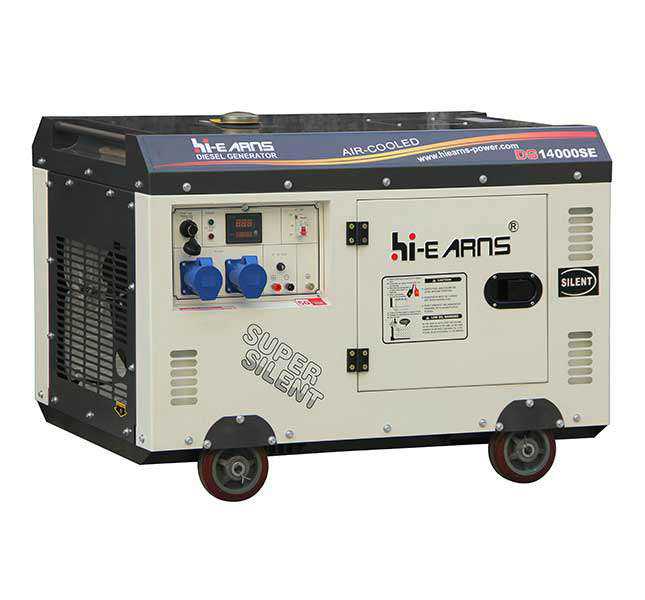
Using the example above, a 20 percent buffer on 4,300W gives you 5,160W. You would need a generator rated at least 5.2kW. The Hi-earns DG11000SE delivers a rated output of 7.5KW at 50Hz, which provides comfortable headroom for typical home backup needs. This model serves as a solid example of an air cooled diesel generator sized for residential use.
You must also match voltage and phase requirements. Single-phase power serves most residential applications. Three-phase power serves industrial equipment and large facilities. Check your equipment's nameplate for voltage requirements. In North America, standard outlets provide 120V, while heavy appliances like ranges and dryers use 240V. In Europe, household supply runs at 230V.
Region | Standard Residential Voltage | Typical Use |
|---|---|---|
North America (US) | 120V (single phase) | Standard outlets and light fittings |
North America (US) | 240V (split-phase) | Heavy appliances (ranges, dryers, HVAC) |
Europe | 230V (single phase) | Household supply |
Three-phase systems use approximately 25% less conductor material than equivalent single-phase systems for the same power output. This makes them more efficient for power transmission in generator applications. However, for most homes, a single-phase generator matches your needs perfectly. Verify your voltage requirements before purchasing to avoid compatibility issues.
Specific fuel consumption (SFC) measures how much fuel your engine burns to produce one kilowatt-hour of electricity. You calculate it as the ratio of fuel mass flow rate to brake power output. The formula looks like this:
BSFC = ṁf / P
Where:
BSFC = Brake-specific fuel consumption (g/kW·h)
ṁf = Fuel mass flow rate (kg/h)
P = Brake power output (kW)
A lower SFC number means your generator uses less fuel for the same work. This translates directly into lower operating costs over time. For air-cooled diesel engines, typical SFC values range from 190 to 230 g/kWh. Industry estimates often use 210 g/kWh as a planning figure. The Hi-earns DG11000SE achieves 230 g/kW.h, which equals about 2.4 liters per hour at rated load. This performance places it squarely in the efficient range for its class.
You should always check the SFC rating before purchasing. A difference of just 20 g/kWh can add up significantly over hundreds of operating hours. For example, a generator running 500 hours per year at 7.5 kW output would burn roughly 862.5 kg of fuel at 230 g/kWh. The same unit at 210 g/kWh would consume only 787.5 kg. That difference of 75 kg per year affects your wallet directly.
Your fuel tank size determines how long your generator can run without refueling. You estimate runtime by dividing tank capacity by hourly fuel consumption at your expected load. Most manufacturers rate fuel consumption at full load, but you will rarely run at maximum output continuously.
A practical benchmark for extended use is a 30-liter tank supporting 12 hours of continuous operation at 50% load. This configuration suits overnight backup power or remote job sites where refueling is inconvenient. The Hi-earns DG11000SE carries a 30-liter tank, giving you that full 12-hour window. Some open-frame models offer slightly smaller tanks around 26 liters, which still provide roughly 10 hours of operation under similar conditions.
You should match your tank size to your typical usage pattern. If you need power for short outages only, a smaller tank saves weight and cost. For extended operations or remote locations, prioritize larger tanks. Also consider whether you can safely store extra diesel fuel on site. Diesel fuel has a longer shelf life than gasoline, making it more practical for emergency reserves.
Diesel fuel offers another advantage beyond shelf life. It contains more energy per liter than gasoline. This higher energy density means a diesel generator produces more power from the same volume of fuel. Combined with compression ignition, which is inherently more efficient than spark ignition, diesel engines deliver superior fuel economy under steady or heavy loads. They also produce stronger torque at low RPM, making them ideal for driving pumps and compressors.
Comparison Aspect | Diesel Generator | Gasoline Generator |
|---|---|---|
Fuel efficiency under steady/heavy load | Higher (lower fuel burn per kW) | Lower |
Energy density | Higher | Lower |
Ignition method | Compression ignition (more efficient) | Spark ignition |
Torque at low RPM | Superior (handles pumps/compressors well) | Weaker |
Fuel volatility & shelf life | Less volatile, longer shelf life | Highly volatile, shorter shelf life |
Typical application | Commercial, long duty cycles, remote sites | Light-duty portable, budget buyers |
However, you must factor in local fuel prices and availability. Diesel costs more than gasoline in some regions, which can offset its efficiency advantage. Check current prices in your area before deciding. For most buyers, the long-term savings from lower fuel consumption outweigh the initial price difference. An air cooled diesel generator like the Hi-earns DG11000SE delivers these efficiency benefits while maintaining a compact footprint suitable for home or job site use.
Noise levels matter more than most buyers realize. An air cooled diesel generator without soundproofing produces roughly 100-110 dBA at one meter. That volume equals standing next to a chainsaw. You cannot hold a conversation. Your neighbors will not appreciate it either.
Modern designs solve this problem with silent canopies. The Hi-earns patented canopy reduces noise to acceptable levels around 70-80 dBA. That range compares to a vacuum cleaner or heavy traffic. You can operate it near your home without disturbing sleep or conversation.
Check the decibel rating before you buy. The EPA recommends 45 dB indoors for sleeping spaces and 55 dB outdoors as a general community limit. A generator rated at 75 dBA at one meter will measure lower at a distance, but you should verify the manufacturer's testing conditions. Some brands measure at seven meters instead of one, which makes numbers look better than reality.
Enclosure Type | Noise Level @ 1m |
|---|---|
Open Skid (no enclosure) | 100-110 dBA |
Silent Canopy (typical) | 70-80 dBA |
Consider your proximity to neighbors. If you live in a dense residential area, choose a quieter model. For remote job sites, noise matters less. Your environment dictates the acceptable threshold.
Durability starts with the engine. Look for a single-cylinder, four-stroke design with direct injection. This configuration delivers reliable starts and consistent power. The Hi-earns DG11000SE uses a 16HP HR198FD engine that meets these criteria.
The alternator deserves equal attention. Insist on 100% copper wire windings. Copper conducts electricity better than aluminum, reducing energy losses. It also dissipates heat more efficiently, which extends component life. Copper resists corrosion better and withstands mechanical stress from thermal expansion. These advantages translate to fewer breakdowns and lower maintenance costs over the machine's lifetime.
Advantage | Why It Matters |
|---|---|
Higher electrical conductivity | Lower resistive losses, better efficiency |
Better thermal performance | Reduces overheating risk, extends lifespan |
Greater durability | Withstands mechanical stress and thermal cycling |
Corrosion resistance | Forms protective oxide layer, resists oxidation |
Long-term cost-effectiveness | Lower energy losses, reduced maintenance |
The frame material determines how well your generator survives rough handling. Steel offers maximum strength and impact resistance for construction sites. Aluminum weighs less and resists rust, making it easier to move. Stainless steel suits coastal or chemical environments where corrosion threatens longevity.
Portability features complete the package. Look for four wheels and a sturdy handle. The Hi-earns model includes these, plus a well-designed air duct for heat dissipation in enclosed spaces. A 30-liter fuel tank adds weight, so mobility features become essential. You want a generator you can position without straining your back.
The sticker price is only the beginning. You must look beyond it. A cheaper generator may have higher fuel consumption. It may need more frequent maintenance. These costs add up over 5-10 years. You can calculate total cost of ownership by combining purchase price, fuel cost, and maintenance expenses.
Fuel cost depends on specific fuel consumption (SFC). A lower SFC means you burn less diesel per kilowatt-hour. Over hundreds of operating hours, the savings become significant. For example, a generator running 500 hours per year at 7.5 kW output will consume a large amount of fuel. A difference of just 20 g/kW.h in SFC can save you hundreds of dollars annually. The same applies to maintenance. Cheaper units often use lower-quality components. You may need to replace oil, filters, and belts more often. You may also face more frequent repairs. These hidden costs can make a budget model more expensive in the long run.
An air cooled diesel generator with a well-designed engine and durable alternator reduces these long-term costs. Look for a model with a reputation for reliability. The initial investment in a quality generator pays off through lower operating expenses.
A solid warranty gives you peace of mind. Look for at least 1-2 years of coverage. This protects you from manufacturing defects. But the warranty is only as good as the dealer network. A responsive dealer can provide parts and service quickly. You do not want to wait weeks for a replacement part during a power outage.
Established manufacturers offer better support. Hi-earns, for example, has been in business since 2005. It holds CE and ISO certifications. ISO 9001:2015 is a quality management standard. It ensures the company follows processes for customer focus, continual improvement, and fact-based decision making. CE marking shows the generator meets EU safety, health, and environmental requirements. It is a legal declaration of conformity. To verify CE certification, you should demand the full document package. Check the model coverage and the issuing body in the EU NANDO database. Avoid the “China Export” lookalike mark.
Optional features also add value. An automatic transfer switch (ATS) lets the generator start automatically during a power outage. Remote control and digital modules give you monitoring and control from a distance. These features may raise the upfront cost. But they can justify the investment for specific use cases, such as remote job sites or homes with frequent outages.
Making the right choice follows a clear path.
Calculate your power needs using starting and running wattage for every appliance you plan to power.
Evaluate fuel efficiency through specific fuel consumption and fuel tank capacity for your expected runtime.
Assess noise levels and build quality for your specific environment and portability requirements.
Compare total cost of ownership and manufacturer support, including warranty and dealer network.
The best generator does not carry the highest price tag. It matches your specific power needs, noise tolerance, and long-term maintenance budget. Create a shortlist of models using the factors above. Consult a dealer to verify your load calculations before purchasing.
A well-chosen generator delivers peace of mind. You gain confidence knowing you can handle any power outage. Your investment pays off through reliable operation year after year.
List every appliance you plan to run. Write down each item's running watts. Identify the single highest starting wattage among them. Add that starting wattage to the total of all running watts. This gives you your peak load.
The Hi-earns DG11000SE consumes about 2.4 liters per hour at rated load. Its specific fuel consumption measures 230 g/kW.h. This value places it in the efficient range for its class. Lower numbers mean lower operating costs over time.
A silent canopy reduces noise to approximately 70-80 dBA at one meter. This level compares to a vacuum cleaner or heavy traffic. You can operate it near your home without disturbing sleep or conversation. Always check the manufacturer's dB rating before purchase.
Single-phase power serves most residential applications. Three-phase power works for industrial equipment and large facilities. Check your equipment nameplate for voltage requirements. Most homes need a single-phase generator. The Hi-earns DG11000SE delivers single-phase power suitable for typical home backup.