



Hotline 0086-519-86239986

All News
Construction sites demand reliable power in tough conditions. Remote locations, shifting loads, and dust-filled air test every piece of equipment. An air cooled diesel generator often becomes the backbone of daily operations. Picking the right model directly affects your project timeline and crew safety. What factors truly matter when selecting one? You need a clear path through power needs, cooling demands, durability, regulations, and cost. This guide gives you that path. It helps you ask the right questions before you buy. A smart choice protects your budget and your workers. Proper selection keeps your project moving forward. This step deserves your full attention.
Calculate your total power needs carefully. Add running watts for all tools. Include the highest starting surge. Add a 20-25% safety margin.
Place the generator outdoors in a well-ventilated area. Keep it at least 20 feet from buildings. Direct exhaust away from windows and doors.
Check local noise and emission rules. Choose a silent canopy model if needed. Ensure the generator meets Tier 4 Final or other standards.
Inspect the air filter often on dusty sites. Replace it when the engine runs rough or fuel use increases. Keep maintenance access clear.
Compare total cost of ownership. Consider fuel, parts, and downtime. A efficient, durable generator saves money over time.
Sizing starts with a complete inventory of every tool and piece of equipment you plan to run at the same time. Do not guess. Check each item's label or manual for its power requirements. Follow this method to build an accurate load profile.
List every item you need to power simultaneously.
Find the running watts for each item. Most tools list running watts directly on the label. If the label lists amps instead, use the formula: Watts = Volts × Amps. Standard US equipment voltage is 120V or 240V.
Identify starting watts for motor-driven equipment. Starting watts are typically two to three times the running wattage for motor-driven equipment. Check the label or spec sheet for the exact figure.
Add the running watts for every item to get total running wattage. Then take the single highest starting watt figure from your list and add it to your total running wattage. Total Power Requirement = Total Running Watts + Highest Single Starting Watts.
Convert to kilowatts if needed. Kilowatts = Watts ÷ 1,000.
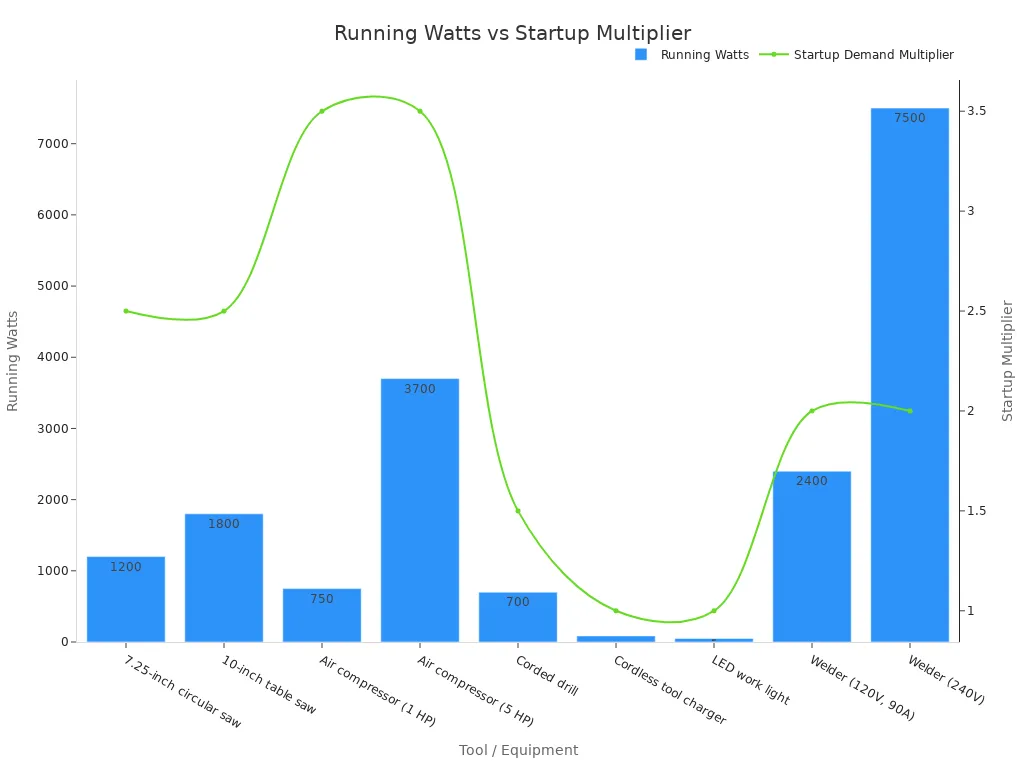
Motor-driven tools demand far more power at startup than during normal operation. A 7.25-inch circular saw draws roughly 1,200 running watts but needs 2 to 3 times that figure to start. A 5 HP air compressor pulls about 3,700 running watts and requires 3 to 4 times that amount at startup. Your generator must absorb the largest single surge while everything else keeps running.
Every motor-driven appliance requires 2-3x more watts to start than to run continuously. A refrigerator running at 150 watts may need 450-600 watts to start. A 1 HP well pump running at 1,000 watts needs 2,500-3,000 watts to start. Your generator must handle the highest starting surge while everything else is already running. Size your generator for the largest single surge on top of your running total, not running watts alone, and not the sum of every appliance's surge added together.
The Hi-earns DG11000SE handles medium-duty site tasks with a rated output of 7.5KW and a maximum output of 8KW. The DG11000E offers similar power in a budget-friendly open-frame design. Most air cooled diesel generator models span the 5kVA to 10kVA range, which suits small to medium power backup applications well.
Continuous power is the wattage your generator supplies indefinitely. Peak demand is the brief surge needed when a large motor starts. These two figures drive your sizing decision.
Industrial sizing methodology totals the running watts of every piece of equipment powered simultaneously. Next, it identifies the highest starting watts demanded by any single motor-driven load, typically compressors, submersible pumps, or arc welders. The minimum generator output equals the sum of total running watts plus that single highest starting surge. From there, apply a 20 to 25 percent safety margin to account for voltage fluctuations, future load additions, and temperature derating. Convert the total kilowatt requirement into kVA using a standard industrial power factor of 0.8. If your site sits above sea level, apply altitude derating of roughly 3 percent power loss for every 1,000 feet of elevation.
A generator sized only for continuous power will trip breakers or stall when a compressor kicks on. A unit sized for peak demand alone wastes fuel and money. Balance both figures against your actual work schedule.
An air cooled diesel generator relies on steady airflow to shed heat. You must place the unit where nothing blocks the intake or exhaust paths. A corner with walls on two sides traps hot air. The engine then pulls its own heated exhaust back through the cooling fins. That cycle raises operating temperatures fast. Keep at least a few feet of clear space on every side of the enclosure. Check the site layout before you commit to a spot.
Exhaust gases carry carbon monoxide and other dangerous fumes. You must follow strict placement rules on every job site.
Operate portable generators outdoors only.
Place the unit at least 20 feet away from homes and buildings.
Direct exhaust away from windows, doors, and vents.
Never start a fuel generator indoors or in a partially enclosed building.
Never run a fuel generator inside or near enclosed structures, unfinished buildings, trailers, or enclosed work areas.
These rules protect your crew from silent, deadly gas buildup.
High ambient temperatures rob an engine of power. Hot air holds less oxygen per cubic foot. The engine then burns less fuel per cycle and produces fewer kilowatts. You must account for this loss when you size your unit. A generator rated at sea level on a cool day will not deliver that same output on a 110°F afternoon.
Altitude compounds the problem. Power output drops become significant above 1,500 meters. For every 300 meters of additional elevation, diesel engine power typically falls by about 4 percent. At 4,000 meters, the engine may produce only 60 percent of its sea-level rating. As a general rule, generator power drops by approximately 8 to 12 percent for every 1,000 meters of altitude gain. A 100 kW generator at 3,000 meters may deliver only 70 to 80 kW. That shortfall risks overload shutdown and equipment damage.
Reduced air density also weakens cooling. The cooling air carries less mass, and the lower boiling point of coolant hurts heat rejection. Always specify your installation altitude when buying. Add a 20 to 30 percent power margin at roughly 3,000 meters. Choose a generator with altitude-rated output.
Construction sites throw dust, grit, and debris at every piece of equipment. Your air cooled diesel generator must resist these particles to keep running. The air filtration system is your first line of defense. A dual air filter system traps dust and airborne particles before they enter the engine. This design supports cleaner air intake and maintains dependable engine operation in dusty conditions.
Filter selection matters greatly. Paper (pleated) filters offer excellent filtration but clog quickly in heavy dust and are not cleanable. Foam filters are reusable, can be cleaned and re-oiled, and trap fine dust well. Synthetic or multi-layer filters provide the best airflow-to-filtration ratio and resist humidity. For daily outdoor use, choose a heavy-duty or multi-layer synthetic filter. Match the filter to your engine brand and OEM specifications for optimal airflow and sealing. Verify compatibility with your generator model to prevent gaps that let dust bypass the filter.
Easy access to service points keeps your generator running through long project phases. You need clear access to oil filters, air filters, and fuel lines for routine maintenance. In clean indoor conditions, inspect or replace the air filter every 200 to 300 hours of operation. In dusty construction environments, inspect every 50 to 100 hours. Replace the filter when it looks dark or cloudy after tapping, when the engine runs rough, when you notice more exhaust smoke, or when fuel consumption increases.
The Hi-earns DG11000SE supports this maintenance routine with practical features. A digital panel provides warnings and full protection. An air duct allows convenient heat dissipation. A 30L fuel tank delivers up to 12 hours of continuous operation. These features reduce downtime and keep your crew working.
You must check your local noise ordinances before you position any generator on site. Many cities set strict limits on equipment noise, especially during nighttime hours. Daytime noise limits for residential areas sit around 55 dB(A). Nighttime limits drop to 45 dB(A). These rules may restrict your operating hours or require you to use silenced models. Always verify the rules for your specific location.
Silent canopy models and open-frame models differ greatly in noise output. The table below shows typical noise levels for each canopy class.
Canopy Class | dB(A) at 1 m | dB(A) at 7 m | Typical Application |
|---|---|---|---|
Open type | 95-110 | 80-95 | Industrial yards only |
Standard canopy | 70-75 | 60-65 | Construction, factories |
Super silent | 65-72 | 58-65 | Hotels, residential |
Ultra silent | 60-65 | 55-60 | Hospitals, recording |
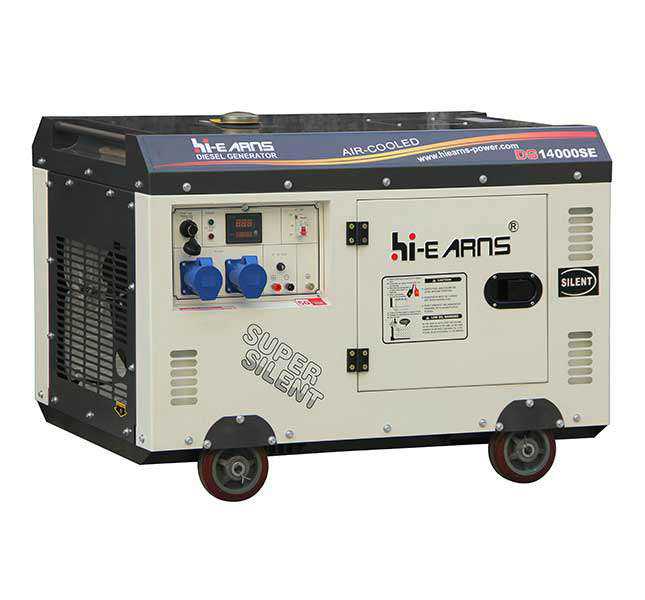
A standard canopy generator delivers 70-75 dB(A) at 1 meter from the canopy wall. This level suits most construction sites. The Hi-earns DG11000SE uses a big silent canopy with four wheels. This design keeps noise low and allows easy mobility. The open-frame DG11000E offers similar power at a lower price point, but it produces higher noise levels. Choose the silent model for noise-sensitive areas.
Emission standards limit the pollutants your air cooled diesel generator may release. Tier 4 Final represents the strictest tier for off-road diesel engines in the United States. This standard cuts particulate matter and nitrogen oxides sharply compared to earlier tiers. You must confirm that your generator meets the emission rules for your region. Non-compliant units can trigger fines or force you to shut down operations.
CE and ISO certifications serve as reliable indicators of quality and safety. CE marking shows the product meets European health, safety, and environmental requirements. ISO certification confirms the manufacturer follows recognized quality management systems. The Hi-earns DG11000SE carries both CE and ISO certifications. These marks give you confidence that the generator complies with major regulatory frameworks. Always ask for certification documents before you buy. This step protects your project from legal and environmental risks.
The purchase price is only the first number you pay. Fuel, maintenance, and downtime drive the real cost over a project's life. A cheaper generator that burns more fuel every day can cost you far more than a efficient model with a higher sticker price. You must compare upfront price against long-term operational costs before you commit.
Fuel consumption is the largest ongoing expense for any diesel generator. The Hi-earns DG11000SE consumes 230 G/KW.H or 2.4 L/H. That figure means the unit burns 2.4 liters of diesel every hour at rated load. Over a 12-hour workday, that adds up to roughly 28.8 liters. Multiply that by your local diesel price and the number of workdays in your project. The total often exceeds the generator's purchase price. A more efficient air cooled diesel generator saves you money every single day you run it.
Replacement parts and service access affect your total cost just as much as fuel. A generator with scarce parts sits idle for days while you wait for a shipment. That downtime stalls your entire crew. You need a model with readily available filters, belts, and injectors. Check whether local dealers stock parts for your chosen brand. Verify that the manufacturer offers a reliable service network in your region.
Hi-earns supports its customers with OEM/ODM services and competitive pricing directly from the manufacturer. That direct relationship cuts out middleman markups on parts and new units. A higher upfront cost for a durable, efficient model leads to a lower total cost of ownership over the project lifecycle. You avoid repeated repairs, reduce fuel bills, and keep your crew working. That combination protects your budget far better than a low initial price ever could.
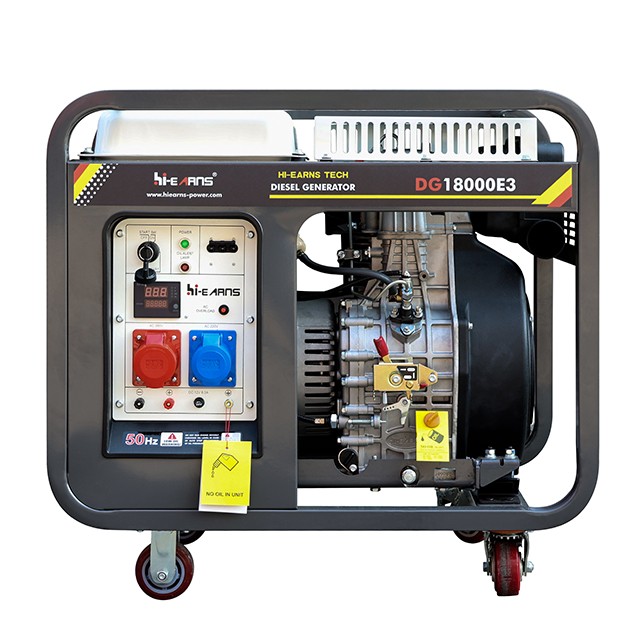
You face a fundamental choice between two cooling designs. Each suits different site conditions. The table below compares them across the dimensions that matter most.
Dimension | Air-Cooled Diesel Generators | Liquid-Cooled Diesel Generators |
|---|---|---|
Performance | Suitable for lighter loads and intermittent use. Cooling capacity drops in high ambient temperatures or poor ventilation. | Superior heat dissipation. Stable under continuous heavy loads and in high-temperature environments. |
Maintenance | Simpler. Clean fans and cooling fins to prevent dust buildup. Users can handle this after brief training. | More complex. Check coolant, radiator, water pump, hoses, and leaks. Requires professional personnel. |
Cost | Lower upfront purchase and installation cost. Good fuel efficiency because no water pump drains engine power. | Higher upfront cost. Slightly less fuel-efficient because the circulation pump consumes engine power. |
Liquid-cooled units last significantly longer, ranging from 60,000 to 90,000 hours. Air-cooled units typically run 1,000 to 3,000 hours. That gap matters for long projects. An air cooled diesel generator remains the smarter pick for smaller loads, remote sites, and intermittent duty. Liquid-cooled models win for continuous heavy loads and extreme environments.
Site managers need a repeatable process. Work through these points before you commit to any unit.
Calculate power needs. Sum the running watts of every tool. Add the highest single starting surge. Apply a 20 to 25 percent safety margin. Avoid oversizing, which causes underload, soot, and clogged filters.
Assess site ventilation. Place the unit on level, load-bearing ground. Keep cooling air paths clear. Never direct exhaust into work areas. Use outdoor IP54 or indoor IP43 enclosures at minimum.
Check noise and emission rules. Keep equivalent continuous sound at or below 70 dB(A) for office workplaces. Choose Stage V designs for city centers, tunnels, or enclosed areas.
Verify electrical safety. Ground the generator at one point. Confirm fault protection through grounding and an RCD. Measure earthing resistance: 50 ohms maximum for TN systems, 100 ohms for IT systems. Use H07RN-F or H07BQ-F cables. Plug devices must meet IPX4 at minimum, and hand or floor lamps need IP55.
Evaluate maintenance access. Confirm clear reach to oil filters, air filters, and fuel lines. Test safety shutdown devices and control panels. Document every defect and follow-up action.
Compare total cost of ownership. Weigh purchase price against fuel, parts, and downtime over the project lifecycle.
Hi-earns stands as a trusted manufacturer for this framework. The company produces over 6000 sets monthly and exports to about thirty countries. Its air-cooled lineup spans 2 to 10KW, giving you options that fit small and medium site demands.
Accurate power calculation, proper ventilation, and local regulation compliance form the foundation of every smart choice. Treat durability and maintenance access as non-negotiable on any construction site.
Key Factor | What to Check |
|---|---|
Sizing | Calculate running watts and surge loads; 5kVA to 10kVA suits most sites |
Placement | Keep exhaust at least 20 feet from windows and vents |
Noise | Enclosed models run around 65–70 dB at 7 meters |
Maintenance | Oil changes and air filter swaps cover most needs |
Prioritize a generator that balances power needs with operational cost and regulatory compliance. Proper selection protects your timeline, crew, and budget. Choose well today, and your air cooled diesel generator will carry your project through to completion.
Add the running watts of every tool you plan to use at once. Then add the highest starting surge from your largest motor-driven tool. Apply a 20 to 25 percent safety margin. The Hi-earns DG11000SE delivers 7.5KW rated and 8KW maximum output for medium-duty tasks.
No. You must operate portable generators outdoors only. Place the unit at least 20 feet from buildings. Direct exhaust away from windows, doors, and vents. Carbon monoxide builds up silently and poses a deadly risk to your crew.
Inspect the air filter every 50 to 100 hours in dusty conditions. Replace it when the engine runs rough or fuel consumption rises. Check oil filters and fuel lines regularly. The Hi-earns DG11000SE offers easy access to all service points.
Power output drops roughly 4 percent for every 300 meters above 1,500 meters. Cooling also weakens at high elevations. You should add a 20 to 30 percent power margin at roughly 3,000 meters. Always specify your installation altitude when buying.
Yes, when noise rules apply. A standard canopy runs 70-75 dB(A) at one meter. Open-frame units produce 95-110 dB(A). The Hi-earns DG11000SE silent canopy keeps noise low and includes four wheels for easy mobility. Check your local ordinances before you decide.