



Hotline 0086-519-86239986

All News
You choose the right diesel water pump by matching seven factors to your job: flow rate, total head, pump type and size, engine power, fuel and operating costs, supplier reliability, and avoidance of common mistakes. Each factor protects your investment. Flow rate and total head set the duty point, so a mismatch here causes oversizing or undersizing. Liqenpower notes that a pump selected by motor power alone can deliver wrong flow, wrong head, and poor efficiency. Pump type and engine power then determine efficiency and wear. Fuel and operating costs shape long-term spend, while supplier reliability guards uptime. This guide follows the same order you should use when evaluating a purchase.
Match the pump's flow rate and total head to your job to avoid oversizing or undersizing.
Choose the right pump type and engine power for efficiency and long life.
Consider fuel and operating costs over the pump's full life to save money.
Check supplier reliability, warranty, and parts availability to prevent downtime.
Avoid common mistakes like buying on price alone or skipping verification steps.
Flow rate is the volume of water your diesel water pump moves per unit of time. You will see it written as gallons per minute (GPM) or cubic meters per hour. This number sets the size of the whole system, so estimate it from the job itself, not from a guess.
For irrigation, work backward from the field. Firgelli Automations gives the basic relation as GPM = (Area × Application Rate × 453.3) ÷ Time, where area is in acres, application rate is in inches per hour, and time is the hours you have to irrigate. The 453.3 factor converts acre-inches per hour into gallons per minute, since one acre-inch equals 27,154 gallons.
Item | Details |
|---|---|
Basic equation | GPM = (Area × Application Rate × 453.3) ÷ Time |
Worked example | 5 acres, 1.0 inch/hour, 4 hours: (5 × 1.0 × 453.3) ÷ 4 = 566.6 GPM total |
Per-acre check | 566.6 ÷ 5 = 113.3 GPM per acre |
For dewatering, divide the volume you must remove by the time you have. A 1,000-liter tank draining at 20 liters per minute empties in 1,000 ÷ 20 = 50 minutes, according to Water Tank Calculator. Construction crews use the same logic to schedule pit and basement dewatering around concrete pours and safe working windows.
Total dynamic head (TDH) is the total resistance the pump must overcome. It combines three parts: the vertical lift from the water source to the pump, the discharge height to the outlet, and friction losses through pipes, fittings, and valves. BB Pumps expresses it as TDH = Static Head + Friction Head (suction and discharge) + Velocity Head difference.
Component | What it means |
|---|---|
Static head | Elevation difference between source and destination |
Friction head | Loss from pipe length, diameter, and fittings |
Velocity head | Energy tied to water speed, calculated as V² ÷ 2g |
Friction loss grows quickly with long runs and narrow pipe. A Darcy-Weisbach relation, cited by Firgelli Automations, shows loss rising with pipe length and with the square of velocity. Undersize the head figure and the pump runs off its best-efficiency point. Flow drops, fuel burn rises, and the impeller wears faster. Measure the actual lift and pipe run on site before you commit to a model.
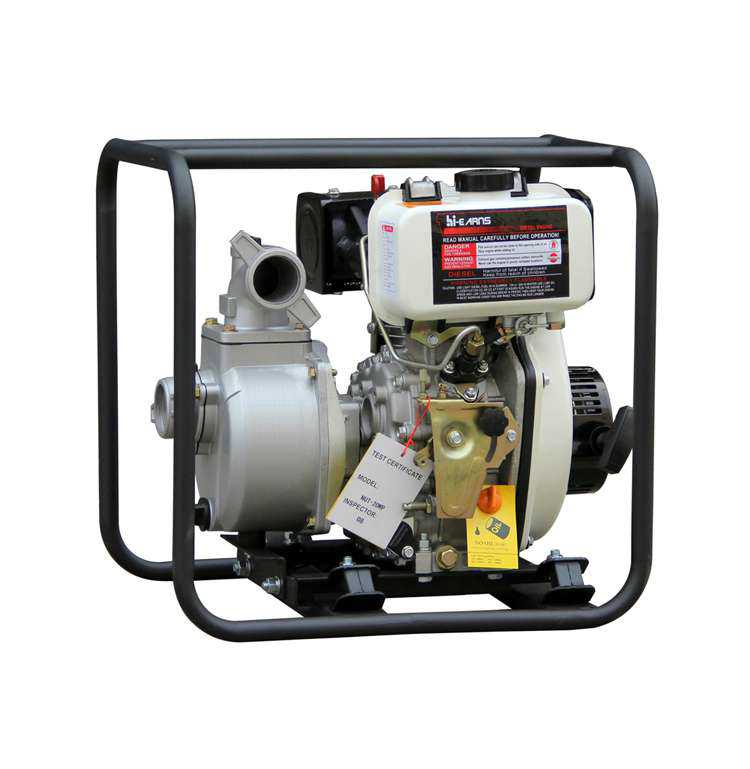
You now have two numbers: required flow and total dynamic head. The next step is to find a model whose published curve passes through that duty point. Do not pick a pump by engine size alone. A large engine on a small impeller wastes fuel, and a small engine on a large impeller stalls under load.
Start with the discharge size. A 2-inch outlet suits modest irrigation plots and light transfer work. A 3-inch or 4-inch outlet moves larger volumes for field-scale irrigation and site dewatering. Then check the head rating at your required flow, not at shutoff. A pump rated for high head at zero flow may deliver far less at your working flow.
Hiearns illustrates the range of options a buyer will meet. The DP30E, DP30HCIE, and DP40E cover flow rates up to 4 inches, with engine options from 4HP to 10HP. Many models include electric start, which saves time on repeated starts in the field.
Match the pump style to the duty. Clean water pumps suit irrigation and general transfer. High-pressure cast iron pumps handle harsh, high-pressure duty and resist wear over long service. Trash pumps pass solids and fit construction sites. Water-cooled models suit continuous operation, and aluminum alloy models keep weight down for frequent movement in field irrigation. Each style has a place; the job decides which one.
Most diesel water pump models for irrigation and dewatering are centrifugal. An impeller spins and throws water outward, converting kinetic energy into pressure. DHK Pump describes the head-capacity curve as a downward-sloping line: as flow increases, developed head decreases. Your pump runs where this curve crosses the system resistance curve. This behavior suits high-flow, moderate-head jobs.
Positive displacement pumps trap a fixed volume and push it out. DHK Pump notes that flow stays nearly constant regardless of discharge pressure, limited only by driver power and mechanical strength. The table below summarizes the contrast.
Parameter | Centrifugal Pump | Positive Displacement Pump |
|---|---|---|
Operating principle | Kinetic energy via impeller | Trapped volume displacement |
Flow vs. head | Inverse: flow drops as head rises | Nearly constant flow regardless of head |
Maximum pressure | Moderate per stage | Very high in a single stage (up to 1,000 bar) |
Flow pulsation | Smooth, continuous | Pulsating |
Viscosity limit | Up to about 500 cSt with corrections | Handles 1,000,000+ cSt with proper suction design |
For clean water at high volume, choose centrifugal. For dosing, metering, or viscous fluids, positive displacement fits better. DHK Pump also notes that viscosity shifts a centrifugal curve downward and left, so a pump picked for water performance delivers less on thicker fluids.
Engine power must match the pump curve, not exceed it by guesswork. Kangjin Power advises calculating total dynamic head and required flow first, then selecting an engine with about 20% more power than the pump requires. That buffer covers wear and changing field conditions. Most industrial pumps run best between 1,800 and 3,000 RPM, so confirm the engine's peak torque lands near the pump's most efficient speed. A diesel water pump that runs outside this band vibrates more and wears faster.
Torque deserves as much attention as horsepower. MHI explains that horsepower measures how fast work gets done, while torque measures turning force. An irrigation pumpset has a fixed direct drive, so it cannot shift gears when the water table drops or a pipe run lengthens. A high-torque engine holds its speed through that added resistance. A high-RPM engine loses speed, overheats, and burns more fuel trying to recover. When you compare 5HP or 10HP options, read the torque curve, not just the badge.
An undersized engine runs constantly at its maximum output. DHK Pump links this overload to very short service life, frequent overheating, and high fuel consumption per unit of water pumped. An oversized engine sits at low load, often near 40% of capacity. That condition brings poor fuel efficiency, incomplete combustion, and wet stacking, where unburnt fuel collects in the exhaust. DHK Pump notes that diesel engines are most efficient around 75–90% of rated load, so aim for that band during normal duty.
Cooling style follows the same logic. Air-cooled engines suit portable field use: they are lighter, simpler, and cannot freeze in winter. Water-cooled engines hold a stable block temperature, typically 85°C to 105°C, which suits continuous heavy duty. Match the cooling system to how long the pump runs, and the engine will reward you with steady output.
Fuel consumption is one of the most important operating cost factors in any diesel pumping system. Liqenpower lists four drivers: engine load, pump efficiency, operating hours, and engine design. You control the first two through correct sizing. A pump that runs close to its optimal efficiency point uses noticeably less fuel than one pushed off its curve.
Engine load: aim for the efficient band, not idle or full overload
Pump efficiency: a well-matched impeller moves more water per liter of fuel
Operating hours: long run times magnify every inefficiency
Engine design: modern combustion systems burn cleaner and leaner
Light loading carries a hidden penalty. Ramesh Babu Siddavatam describes wet stacking as unburnt fuel that collects in the cylinders and exhaust. Short run times and light loads cause it. The result is reduced combustion efficiency, higher fuel consumption, carbon buildup, and premature engine failure. Size your diesel water pump so normal duty keeps the engine working, not idling.
Purchase price is only the first line of the ledger. Flowatts gives the total cost of ownership over a fixed period as TCO = I + (O + M + D) - R, where I is initial capital cost, O is operational costs such as fuel, M is maintenance and repairs, D is downtime costs, and R is remaining or salvage value. BB Pumps builds a similar ten-year view: initial unit cost, lifetime energy, maintenance and parts, downtime cost, and the ten-year total.
DHK Pump adds categories buyers often forget. Initial costs include shipping, installation, and commissioning. Energy costs depend heavily on pump efficiency and system design. Maintenance covers labor, lubricants, and wear parts such as impellers, liners, and seals. Downtime and production loss is the most significant and frequently underestimated category, covering lost revenue and idle labor. End-of-life costs include disposal or residual resale value. Compare models on this full picture, not the sticker.
Picture a 5-acre vegetable plot with a pump that must move water to a drip line 60 feet uphill. You need portability, so an aluminum alloy pump body keeps the unit light enough for one person to reposition between fields, as Liqenpower notes for its lightweight models. Fuel efficiency matters across a long season. Liqenpower lists typical consumption of 0.8–1.0 L/hour for a 5HP unit and 1.5–1.8 L/hour for a 9HP unit, so a correctly sized engine protects your budget on every run.
Torque decides whether the pump holds speed when the water table drops or a pipe run lengthens. Liqenpower recommends a 15% to 20% power reserve above the pump's maximum shaft power at operating speed. That buffer prevents stalling under variable field loads. Diesel pumps suit higher-performance, longer-life, fuel-efficient major agricultural applications for exactly this reason.
Now picture a foundation pit filling with muddy water after a storm. Dirty inflow calls for hardened internals and open passages, according to Dewatering Pumps. You should also keep one or two diesel trash pumps on standby for storm surges and bypass work. Selecting a trash pump comes down to four things, per EV Pump: flow rate, solids handling capacity, lift height, and power source.
Durability separates a pump that finishes the job from one that fails mid-shift. EV Pump notes that reliability under pressure matters as much as metallurgy and pump specs. Boom and Bucket warns that abrasive material causes wear, so check the manufacturer's solids-size and fluid specifications before you commit. A well-chosen diesel water pump handles muddy water within those limits and keeps the pit dry through the pour.
A strong supplier shows you a documented quality control system, not just a promise of good workmanship. Ask how the factory tests each unit before shipment and who signs off on the result. A strict quality control system is a supplier strength worth seeking, and it tells you the pump will arrive ready to run.
Warranty terms deserve a close read. Confirm what the warranty covers, how long it lasts, and who pays for freight on a claim. Parts availability matters just as much. DFSPumps advises you to confirm availability and lead time for each spare part rather than assuming a component sits on a local shelf. Service support completes the picture. Ask whether the supplier offers technical help by phone or email and how quickly they respond during the season when your pump must keep running.
Send your first message with the asset details, photographs, required quantity, and maintenance context. DFSPumps notes this gives the supplier a practical basis for discussing compatibility and supply arrangements. Ask for the documentation package in the same message. Liqenpower lists the core documents a buyer should request, and the table below shows the priority for each.
Document | Required For | Priority |
|---|---|---|
BOM | All industrial pump orders | High |
Exploded drawing | Pumps that require field maintenance | High |
1-year spare parts list | New pump orders and standard projects | High |
2-year spare parts list | Critical, remote, or continuous-duty projects | Medium to high |
Interchangeability statement | Plants with multiple similar pumps | High |
Material list for wetted parts | Corrosive, abrasive, chemical, or seawater service | High |
Lead time list | Imported, customized, or long-lead parts | High |
Liqenpower also warns that customs clearance and transport time can matter as much as production lead time for remote sites and imported pumps. Ask the supplier to confirm whether recommended parts are OEM, supplier-approved equivalents, or standard commercial parts. Put the part name, part number, material, quantity, unit price, delivery time, and warranty relationship in the contract. A supplier who answers these questions clearly earns your order.
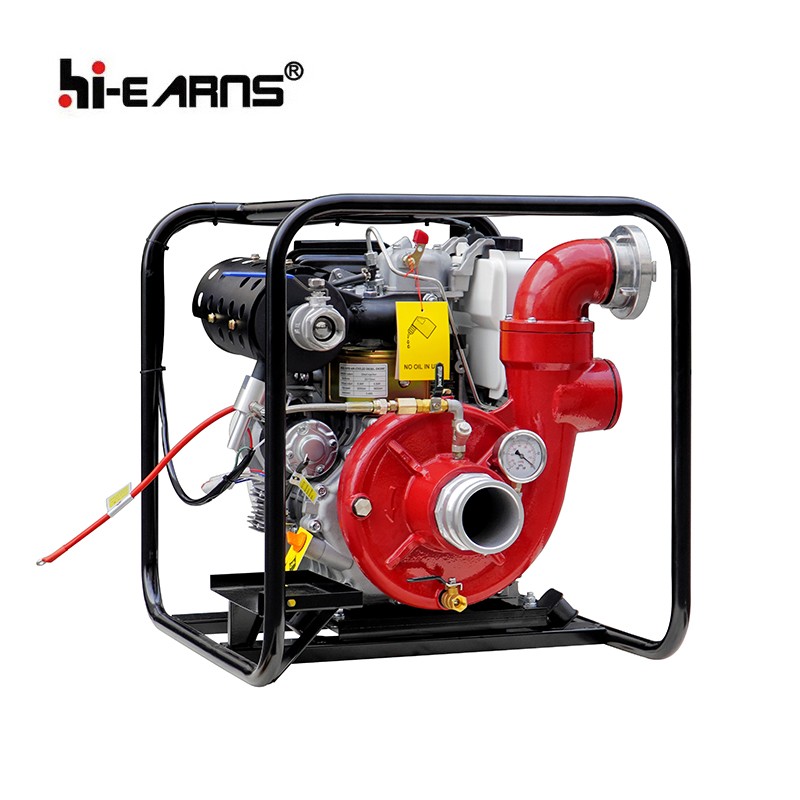
Some failures trace back to the purchase decision, not the job site. Fleetrabbit lists two mechanical causes worth knowing before you buy. A leak at the mounting surface between the pump housing and the engine block is more persistent than a weep hole, and it signals imminent seal failure. A loose pump or a wobbling pulley misaligns the drive, stresses the shaft, and damages the impeller. Both problems reward early action.
Failure cause | Description |
|---|---|
Leak at the mounting surface | More persistent than a weep hole; usually a sign of imminent pump or seal failure. Act soon. |
Pump is loose, or the pulley wobbles | Looseness can misalign the pulley or gear, stress the shaft, and damage the impeller. Act soon. |
Worn shaft seal | Coolant passes the seal and shows at the weep hole. |
Worn bearings | Grinding, growling, or play in the pulley. |
Over-tightened belts | Excess tension shortens bearing life. |
Price alone is a poor guide. Liqenpower warns of several traps:
Sizing the engine at best efficiency instead of maximum shaft power, so it overloads at 110% of design flow
Ignoring altitude and temperature derating, which cuts usable power at elevation
Treating fuel consumption as a constant when it depends on the operating point
Buying on delivered cost without checking warranty labor and parts availability
Skipping coupling and torsional compatibility checks on larger engines
Liqenpower suggests a service margin of roughly 10–25% above the pump's maximum shaft power at the worst expected duty point.
Run a checklist before you sign. Liqenpower recommends confirming flow rate and total dynamic head at the duty point, with static and friction components listed separately. Add liquid type, solids size, installation method, power supply, duty cycle, and dry-run protection. Ask for a performance curve, material certificates, and test reports.
Portability and runtime deserve equal weight. Confirm the unit's weight suits how often you move it, and match the duty cycle to your daily hours. Virheos notes that procurement teams enforcing a full checklist report 60% fewer warranty claims in the first 24 months. A few hours of verification protects a season of work.
Confirm these seven factors before you commit:
Flow rate and total head at the duty point
Pump size and type for the job
Engine power matched to pump demand
Fuel and operating costs over the full life
Supplier quality control, warranty, and parts
Common mistakes avoided through verification
Liqenpower frames the same review around hydraulic data, duty cycle, downtime cost, and spare parts to stock. Matching the diesel water pump to your application remains the single most important decision you will make. A well-matched unit runs efficiently and lasts. A mismatched one wastes fuel and invites downtime.
Confirm your flow, head, power source, and runtime needs with a trusted supplier before you buy. A short conversation now protects a full season of work.
Check two numbers against the model's published curve: your required flow rate and your total dynamic head. The curve should pass through that duty point. A pump picked by engine size alone may deliver the wrong flow and run inefficiently.
No. An oversized engine runs at low load, which brings poor fuel efficiency and wet stacking. Diesel engines work best around 75–90% of rated load. Size the engine with roughly a 20% power reserve above the pump's demand, and confirm the torque curve holds speed under load.
Follow the manufacturer's schedule for oil, filters, and seals. Check the mounting surface between the pump housing and engine block for leaks, and inspect the pulley for wobble before each season. Early action on either fault prevents seal and impeller damage.
Bring your flow rate, total dynamic head, liquid type, solids size, power source, and daily runtime. Ask for the performance curve, warranty terms, and a spare parts list. Clear requirements let the supplier confirm fit and lead time in one conversation.